FROM THE FINAL CALL NEWSPAPER

Obama's next moves: poll numbers are good but challenges remain

By Eric Ture Muhammad -Contributing Writer- | Last updated: Jan 19, 2011 - 12:38:32 AM

Bookmark and Share

What's your opinion on this article?

Printer Friendly Page

obama01-25-2011.jpg
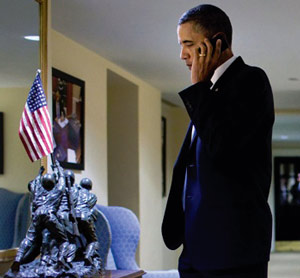
President Barack Obama talks with Arizona Gov. Jan Brewer concerning the shooting of Rep. Gabrielle Giffords and others, on a cell phone in the hallway outside the White House Situation Room, Saturday, Jan. 8, 2011. Photo: MGN Online Courtesy, White House
ATLANTA (FinalCall.com) - The inauguration of President Barack Obama two years ago set a record attendance for swearing-ins in Washington,D.C., and marked the commencement of the four-year term of the nation's first Black president.

Combined attendance numbers, television and Internet audiences made the inaugural one of the most observed events in history.

Compared throughout his campaign to civil rights icon Rev. Dr. Martin Luther King, Jr., Mr. Obama, originally campaigned under the slogan “Change We Can Believe In,” then later, “Change We Need.” He captured world attention as well as the Nobel Peace Prize.

He was born in the 1960s and embodied youthful energy and a much needed transition from a time of economic despair, out of control foreign and domestic policies, wars in Iran and Afghanistan and a departure in the American psyche from his Republican predecessor George W. Bush. His call for change, eloquent speeches on race and campaign promises inspired more confidence in the possibility of change than any of his immediate predecessors.

Two years later and two months since the 2010 midterm election blowout, campaign promises for the most part have still gone unmet. A new Congress commenced Jan. 5 with a swollen, Republican majority in the House (63 new seats). A slower than expected economic recovery and job growth; and a health care bill that might face a constitutional battle in the U.S. Supreme Court this year now squarely sits on the shoulders of the much celebrated president.

The president has been savaged by the right, called a “tyrant,” had his citizenship challenged and been subjected to a tremendous number of death threats. In mid-term congressional elections, some members of his own party ran away from the once popular leader.

“This is still a time of great challenges for us to solve. We've got to grow jobs faster and forge a stronger, more competitive economy. We've got to shore up our budget, and bring down our deficits, We've got to keep our people safe, and see to it that the American Dream remains vibrant and alive for our children and grandchildren,” he said in his Jan. 15 weekly address.

“No matter what Barack Obama says in his State of the Union Address later this month, it is clear where he is headed: ever rightward,” began Black Agenda Report executive director Glen Ford, who has been critical of the president.

“His appointments tell the tale. Obama also gave the game away—that he would govern from the center-right and attempt a grand consensus with the GOP—in the weeks before he was first sworn into office, January 20, 2009,” he said.

According to the editor of the online journal, the Obama appointments of Bill Clinton's Wall Street deregulation crowd to head economic policy and his retention of George W. Bush's secretary of defense to guard and expand the empire, should have signaled to every sober observer that Obama's political orientation might differ dramatically from his predecessor's in tone, but not in substance.

The problem was, there were very few sober Left political observers around two years ago, and nearly all Black folks were falling down drunk on “ ‘ObamaL'aid'—a brain-softening condition that persists among many, to this day,” said Mr. Ford.

Popularity vs. the anti-Obama chorus

Conventional political wisdom says the president must move to the right to have a chance at winning and his core constituents will simply go along with him.

“I really don't think that President Obama has anywhere to come back from because I don't think he's fallen,” said Dr. David Bositis, a senior research fellow at the Joint Center for Political and Economic Studies. Sure Mr. Obama's popularity has gone down, but that has more to do with political and economic trends than his performance and political personality, said Dr. Bositis.

People are dissatisfied about the economy, but have to remember President Obama does not control the economy, Dr. Bositis said. It is historically commonplace that when the economy is bad, the party in office takes the hit and is thrown out, he added. It happened in 2006 and 2008 with the Republicans, and in 2010, it happened to President Obama and the Democrats, Dr. Bositis continued.

“But he's by far the most popular person in the country. He's way more popular than the Republicans and his approval ratings are much higher than Ronald Reagan's and Bill Clinton's were at this point in their presidencies,” Dr. Bositis said.

According to analysts, the right wing media's constant negative portrayal of President Obama has contributed to the perception that he has lost or is losing support, but Dr. Bositis said the anti-Obama chorus is nothing new.

“Remember, it wasn't like 80 or 70 or 60 percent of the people in the country voted for President Obama in 2008.He got about 53 percent of the vote so a lot of the people who are loudest in their complaints about President Obama are people who never liked President Obama to begin with,” said Dr. Bositis.

Author and social commentator Dr. Michael Eric Dyson told The Final Call redemption and recovery for President Obama is always possible.

“I think that President Obama's brilliant speech in the aftermath of the Tucson tragedy reasserts his legitimacy as this nation's leader and also his rhetorical ability to unite the nation around fundamental principles of democracy and civility.And if people would offer him the opportunity to exert his leadership—and if on the other hand he would begin to even more boldly exercise his leadership right then—I think that those two things together would permit him to reassert his presidential persona,” Dr. Dyson said.

Productive sessions after ‘shellacking'

The president had said he looked forward to returning to Washington on the heels of “the anything but lame duck session” of Congress where he successfully negotiated an impressive slew of legislative victories late in the year. Analysts agreed there had not been such a productive session of outgoing congressmen since the presidency of Lyndon B. Johnson.

Mr. Obama is also riding a wave of popularity. The latest Gallup poll showed his job approval rating at 49 percent against 43 percent disapproval with near 7 percent undecided at Final Call presstime Jan. 17.

Pres. Obama called Nov. 2 mid-term elections a “shellacking” for himself and Democrats and faced major issues mired in a legislative stalemate.

Still the president worked out a compromise with Senate Republican leaders to extend Bush-era tax cuts for two more years, extend unemployment benefits for 13 months, and slightly reduce payroll taxes.

“The president and his team found a better approach to governing,” began CNN political analyst and former Clinton presidential aide David Gergen. “Instead of relying on the Democratic caucus in each chamber to deliver, they built up coalitions of their own that swayed public opinion in their direction and gave them leverage in Congress.”

The White House found ways to repeal of the “Don't ask, don't tell” policy that bans openly homosexual men and women from the military and get approval for a nuclear arms treaty with Russia.

Both the House and Senate passed a bill to provide medial treatment and compensation to first responders in the September 11, 2001 terrorist attack in New York and both chambers agreed on a resolution authorizing government funding through March 4.

The president tried to tout the victories as signs Democrats and Republicans could work together.

In addition, the president signed a bill into law a $1.25 billion settlement for Black farmers who say they were discriminated against by the federal government when it came to loans and subsidies. About 30,000 Black farmers are eligible for the settlement.

Rhetoric and appeals to the American people
obama_tucson01-25-2011.jpg
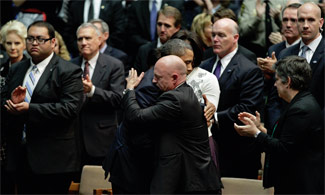
President Barack Obama embraces Mark Kelly, right, the husband of critically wounded Rep. Gabrielle Giffords, D-Ariz., at the end of a ceremony honoring the victims of a shooting rampage on the University of Arizona campus. Applauding at far left is Daniel Hernandez, a University of Arizona political science student who was with Giffords when she was shot. At far right is Homeland Security Secretary Janet Napolitano, the former Arizona governor. Photo: AP Wide World Photos/J. Scott Applewhite, File
The president's eulogizing of six people who died in a Jan. 12 Tucson, Ariz., shooting spree that wounded 14 others—including Rep. Gabrielle “Gabby” Giffords—and his upcoming Jan. 27 State of the Union Address were seen as opportunities to put forward a vision and win voters.

Though President Obama's numbers are reminiscent of former Presidents Ronald Reagan in 1983 and Bill Clinton in 1995, he is still very much in danger of being a one-term president.

Former Presidents Jimmy Carter and George W.H. Bush had significant popularity at midpoint but their second term aspirations fell miserably short.

Facing a divided Congress and polarized electorate, President Obama may return to previous themes of common ground, principled disagreement, dialogue, and compromise.

“What I think is especially interesting about this State of the Union is how similar it will likely be to his other ones,” said Dr. Kevin Coe, a mass media analyst at the University of Arizona.“Obama has made ‘bipartisan compromise' and ‘reaching across the aisle' hallmarks of his rhetoric so far,” he told The Final Call.

“The Republican gains make such rhetoric more relevant. Obama will, early on, make some kind of acknowledgement of the Republican gains, probably couched in the language of ‘change' that he's always used (because) people are ‘dissatisfied with the ways of Washington' and so on. His actual discussion of policy will probably sound a lot like before, highlighting opportunities for bipartisanship,” he concluded.

Craig R. Smith was a full-time speechwriter for President Gerald Ford and a consulting writer for George H. W. Bush. He told The Final Call, “The president will highlight those programs which appeal to a majority of Americans or to his needed constituency (minorities, independents, students, Democrats). Thus, the Dream Act, if not passed by then, will be trotted out in the State Of The Union address, and so will tax reform. The president must address the wars in which he is engaged. He will try to put the best face on them, to highlight where ‘progress' has been made.

“It will be interesting to see if the president lists a bunch of programs, kind of like Clinton's 51 programs in 51 minutes, or he focuses on four or five major initiatives in the domestic section of the speech. For example, he might try to answer the question: Which programs are likely to reduce unemployment? Since he has already reached out to Republicans on the tax issue, it looks as if he is embracing the Clinton strategy of going along with some Republican requests to get along with them, so he has a record of achievement to run on in 2012.”

“The president has tremendous leverage” coming into the second half of his term, said the National Urban League executive director Mark Morial. “Number one, he's got the experiences of the first two years. Number two, he has a strong base of support and goodwill that remains with him. And number three, he has the bully pulpit of the presidency and the veto pen of the presidency, which are both very powerful tools,” he said.

“In the intervening 24 months (since the inaugural), the Right has achieved a near-miraculous comeback, a reversal of fortune that could not have happened without considerable assistance from Mr. Obama,” argued Mr. Ford, of BlackAgendaReport.com. “By positioning his administration to the right of center from the very beginning, becoming more intimately identified with Wall Street bankers even than Bush, and waging relentless war on the Left half of his party, Obama reduced fellow Democrats to a state of demoralized confusion, leading to catastrophic defeat. Defeat, that is, for the party, but not for the president, who has at last arrived in his comfort zone,” he said.

(Charlene Muhammad contributed to this report.)

FROM THE FINAL CALL NEWSPAPER

Billions pledged and raised but Haiti continues to suffer

By Starla Muhammad -Staff Writer- | Last updated: Jan 11, 2011 - 10:41:54 AM

Bookmark and Share

What's your opinion on this article?

Printer Friendly Page

haiti_palace550_01-18-2011.jpg
Presidential palace in ruins after massive January 2010 earthquake in Haiti.
Photo: Richard B. Muhammad

(FinalCall.com) - January 12, 2010 at 4:53 p.m., a life-changing moment forever etched in the hearts, minds and souls of the people living in a small yet mighty island nation, nestled in the Caribbean. The world watched in shock and horror as the first images and reports surfaced about the devastating 7.0 magnitude earthquake that struck Haiti, the world's first Black republic.

The capital city, Port-au-Prince, crumbled to the ground in a country already hurting as the poorest nation in the Western Hemisphere, the result of years of U.S., UN and European-led interference, occupation and influence, say many.

The international community responded immediately as aid and promises of assistance poured in from all over the world.

Over 50 countries initially pledged an excess of $8.75 billion in humanitarian aid but less than 15 percent ($686 million) of that has arrived.

One year later, things have not gotten better and some analysts and activists charge that things in Haiti are “worse off than they have ever been.”

Where is the money and the progress?

2915_haiti_uk_p3.jpg
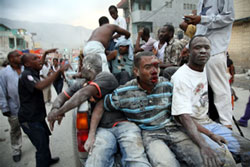
Injured Haitians on a truck headed for medical aid one year ago.
“The fact that nearly half of the donated dollars still sit in the bank accounts of the relief-aid groups does not match the urgency of their own fundraising and marketing efforts of donors' intentions, nor does it convey the urgency of the situation on the ground,” said Ben Smilowitz, executive director of the Disaster Accountability Project.

“It may be a disincentive for future giving by individuals and other governments,” he added.

Besides the thousands of charity groups in the country, two major forces, the Red Cross and the United Nations peacekeepers, have also come under fire.

The Friday Haiti Relief Coalition based in New York has been protesting for months against the American Red Cross and other non-profits for holding on to millions in donations collected for Haitian relief efforts.

According to the Disaster Accountability Project's One Year Report On The Transparency of Relief Organizations Responding to the 2010 Haiti Earthquake, the American Red Cross has raised $479 million for relief and recovery but is on track to spend only $245 million by Jan. 12.

The Friday Haiti Relief Coalition contends with so many people still living in tents and suffering from cholera, holding on to millions of dollars is wrong. “These facts are unacceptable so we must lean on the various organizations that raised millions of dollars for the Haitian people,” posted the group on its Facebook page.

“No amount of excuses, however complicated and bureaucratic can mask this brand of blatant, criminal negligence. With resources come responsibility and the inaction of the ARC and other foreign NGOs is tantamount to genocide,” Gregory Perry of the Friday Haiti Relief Coalition told an online news outlet.

Between 1.5 to 1.7 million Haitians are still homeless with little or no access to medical care, food and clean water. And, the worst cholera epidemic in 100 years effecting over 122,000 people, leaving over 2600 dead and counting, has many activists angry and upset.

Though aid money has been released, it has been exceedingly slow in getting to where it needs to get to help.

Analysts say only 15 percent of temporary housing has been constructed and very few permanent water and sanitation facilities have been built.

The enormous amount of rubble left is being slowly removed. According to Thomas Adams, U.S. State Department special coordinator for Haiti, 2 million cubic meters of rubble has been removed. Critics say this is less than 5 percent. Estimates on the amount of rubble remaining range from 12 to 19 million cubic meters. Depending on certain conditions and implementation of a more effective system of removal, the goal is that by Oct. 2012, another 4 million cubic meters can be removed, said Mr. Adams.

“The hope is that the following year, year and a half the rest could be removed, that's pretty ambitious and again it depends on a lot of conditions being met,” said Mr. Thomas on a Jan. 10 media conference call.

This is not to say the people of Haiti are not right in wishing the pace of reconstruction could be faster, he continued, “I think we all would like it to be faster but compared to other emergencies it's moving along at average or better than average pace in many areas.”

Mr. Thomas also contends that not all of the money pledged from public sector donors for recovery was to be spent in one year and that the pledges for 2010 were approximately $2.1 billion and 63.6 percent ($1.28 billion) of that has been dispersed. However, that does not mean the money has been spent on the ground, only that the money has been obligated to a contractor or to a nongovernmental organization, he continued.

Transparency concerning how aid is being used has also come under scrutiny. Mr. Thomas said they have no data from the recipient organizations on how the money is being spent or if the work is completed. This $1.28 billion was disbursed through four channels:

$233.0 million in budget support to the government of Haiti

$223.6 million in pooled grant funding to the United Nations, Inter-American Development Bank and the World Bank through the Haiti Reconstruction Fund

$688.9 million in grants to the government of Haiti, multilateral agencies, NGOs and private contractors

$135.3 million in loans to the government of Haiti

Haitians in the Diaspora have complained that they have been largely left out of the rebuilding, reconstruction and repair process as well as the decision making process.

“The earthquake only devastated more of an area but the entire island of Haiti is devastated,” said Carmella S. Muhammad, whose parents are from Haiti. The Chicago entrepreneur, fluent in French and Creole, has several relatives still in Haiti. She communicates with family members by telephone and goes online for updates.

Her cousins in Port-au-Prince are in the same condition they were the day of the earthquake, she said, thankful relatives outside of the capital city have been able to offer some shelter.

No voice for the poor

A report released Jan. 6 by Oxfam, an international relief and development organization blamed the lack of progress on a combination of Haitian government indecision, rich donor countries' pursuit of their own aid priorities and a lackluster Interim Haiti Recovery Commission.

The voices of poor Haitians are seldom heard in the policy-making process that directly affects their lives, noted the report. Haitian authorities, along with the international community, should consult, communicate and involve the Haitian people in national reconstruction plans and programs, it continued.

‘Republic of NGOs' usurps Haiti's government?

“Too many donors from rich countries have pursued their own aid priorities and have not effectively coordinated among themselves or worked with the Haitian government. This seriously weakens the government's ability to plan and deliver on its sovereign responsibility—to lead reconstruction,” said Roland Van Hauwermeiren, country director for Oxfam in Haiti Jan. 6.

Oxfam itself is an NGO in Haiti. Maura Hart, humanitarian press officer for Oxfam, admits that there has not been a lot of coordination, joint decision making and input with Haitian organizations on the ground and elsewhere, which may be part of the problem, she said. Asked how many of the thousands of groups in the country are actually run by Haitians, Ms. Hart did not have an exact figure. But, she said, about 90 percent of Oxfam's staff is Haitian.

Not only is monetary aid a problem, but disorganization, bureaucracy and confusion among the non-profit and relief groups entrenched in Haiti has caused a logjam in aid distribution. The Haitian people appear caught in the middle between groups focused on immediate aid versus those focused on long term rebuilding efforts. Also, while U.S. and other groups are receiving contracts to rebuild, Haitian-owned and operated businesses are relying on receiving sub-contracting work from these larger groups—or getting very little else.

The U.S. Agency for International Development gives only $1.60 to Haitian-owned businesses for every $100 spent on contracts. According to the Associated Press, Haitian companies have received $4.3 million, or 20 percent, of contracts totaling $267 million through 2010. USAID's inspector general found that 70 percent of funds given to the two largest U.S. contractors for the cash for work program was spent on equipment and materials. So just 8,000 Haitians a day were being hired for temporary jobs, instead the 25,000-person-a-day target, said the Associated Press.

One quarter of contracts went to U.S. firms with Haitians having no chance to bid, while requests for Haitian subcontractors are often written in English only, meaning little access to most Haitians who speak kreyol, the Associated Press reported.

Inside the United Nations, there were reports of bureaucratic infighting over who would handle money earmarked for Haiti. As the infighting raged, aid simply stalled.

The already tenuous relationship with the United Nations snapped with a cholera outbreak that some outsiders and most Haitians believe originated from unsanitary conditions at a peacekeepers camp. The water borne illness, which causes dehydration, diarrhea, has been fatal, killing upwards of 2,600 people and leaving another 150,000 or more infected. It was unseemly to many that Haitians were dying because they could not get clean water.

“There is no excuse for the cholera epidemic and deteriorating conditions on the ground given the amount of resources donated and available. With hundreds of millions in the bank and unspent, many groups continue to solicit additional donations,” observed Ben Smilowitz of the Disaster Accountability Project.

Partnership, not paternalistic aid needed

Dr. Ron Daniels, president of the Institute of the Black World 21st Century and founder of the Haiti Support Project, has led several delegations to Haiti since the earthquake. Small steps have been made, he said. A failure to engage Haitian organizations on the ground in the beginning was a concern and, to some extent, still is. “If you're going to help a country you need to work with the people who you're providing help for,” Dr. Daniels told The Final Call. Haitians, he continued, know the best methods on how to coordinate efforts of getting aid to the people.

The unfortunate reality according to Dr. Daniels: “The recovery and reconstruction has been plagued by the phenomenon of the republic of the NGOs, that is to say that for far too many years in Haiti you've had a very weak government that has essentially been starved by the international community on the pretext that there's so much corruption.”

According to the website for the United States Institute of Peace, there are at least 3,000 charitable, advocacy, relief or not for profit groups operating in Haiti.

Dr. Daniels said some 10,000 to 14,000 groups, with their own programs and fundraising, are not coordinated with each other or the Haitian government. Fewer than 500 of these groups registered with the Haitian government and it adds to the chaos, he said.

The Clinton Bush Haiti Fund has awarded grants to groups pledging to help in long-term rebuilding and reconstruction efforts and states their goal is for Haitians to lead the way. “We go with Haitian NGOs whenever we can and partner with Haitian NGOs whenever we can,” said Meg Pearce, vice-president of marketing and communications for the foundation.

Attorney and Haitian activist Lionel Jean-Baptiste said historical distain in the U.S., France, Canada and other countries for Haitian independence is reflected in the presence and influence of the NGOs, calling their efforts “poverty pimping.”

“Wherever you have poor people you have a bunch of agencies that are supposed to be healing our ills but they never do,” said Mr. Jean-Baptiste, an elected official in Evanston, Ill.

Although these countries, NGOs, the World Bank and other entities pour millions and billions of dollars into Haiti, it “disempowers the masses of the people and attacks their capacity to be self-determining.”

The sentiment among many Haitians and Haitian Americans after the earthquake is any infusion of capital to provide services to the people should be used to support local businessmen and farmers which would build power in Haiti, he said.

What is coming in is from outside agencies that in some ways established “parallel governance” to the government of Haiti, the attorney continued. While Haiti should not be isolationist or cease partnerships with the international community, he said, partnerships should be based on on generally supporting self-determination. But, he said, “there is a perception that the outsiders know better.”

The fight for inclusion by Haitian and Haitians in the Diaspora on decision making in their home country has been an historical fight that has not changed, Mr. Jean-Baptiste told The Final Call.

It continues to be a paternalistic type of relationship, he said.

“I have friends who have gotten jobs with the Clinton foundation for example, Haitians competent, able, passionate, but they're marginalized in terms of their input.”

What analysts may be saying is one thing but those who get the contracts to go and implement things are not Haitian, said Mr. Jean-Baptist.

“They're established companies that have had a history of coming in and a significant portion of their money is for administrative overhead,” he added.

The Oxfam report noted, “Whatever the weakness of the Haitian government, it remains the sovereign authority whose engagement is essential if relief, reconstruction, and development in Haiti are to be successful.”

A partnership with existing Haitian institutions and government is needed, argued Mr. Jean-Baptiste.

But, he noted, “less than a penny per dollar goes to the Haitian government to do what it has to do to govern the nation.”

Investing in job creation and job growth is important, said Mr. Jean-Baptiste, but “over a million people are still living under tents and rubble is still there.”

Bookmark and Share

FROM THE FINAL CALL NEWSPAPER

Locked down, exploited and mistreated

By Charlene Muhammad and Starla Muhammad -Staff Writers- | Last updated: Jan 4, 2011 - 12:31:55 PM

Bookmark and Share

What's your opinion on this article?

Printer Friendly Page

Concern rises about inmates allegedly beaten by guards in Georgia strike and mistreatment of prisoners detained in institutions across the country

m_jackson01-11-2011.jpg
Miguel Jackson was beaten by guards, according to his family members.
(FinalCall.com) - Like thousands of inmates scattered in prisons across the state of Georgia, Terrance Bryant Dean participated in an eight-day peaceful protest to highlight inhumane conditions in the prisons.

Days later he was brutally beaten by guards at Macon State Prison, his family and a coalition of supporters charge.

When his mother Willie Maude Dean and members of the Concerned Coalition to Respect Prisoners' Rights attempted to visit him at the Atlanta Medical Center on Dec. 31, the hospital claimed her son was no longer there and the corrections department claimed he was moved to Jackson State Prison the night before, according to an alert The Final Call received from Coalition co-chair Elaine Brown.

Ms. Brown said the Coalition found out about the beating during its second fact-finding visit to Smith State Prison on Dec. 30. Its first prison visit was to Macon on Dec. 20.The Coalition asserts the beating was in retaliation for the protest, which began in early December.

In addition, Ms. Dean said the Georgia Department of Corrections has given no information about her son's condition or his whereabouts.

ga_prison_imate01-11-2011.jpg
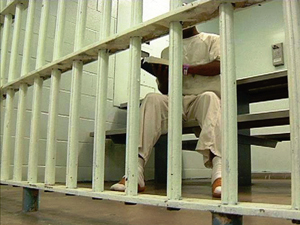
Another inmate allegedly beaten by guards at Smith State prison in Georgia.
The mother told Coalition leaders after their latest visit that Macon State Warden Gregory McLaughlin told her that Terrance was in an isolation cell, but the mother believes he was already in the hospital.

The family of a second inmate, Miguel Jackson alleges he was severely beaten by upwards of 20 guards Dec. 31 during what is called a “shakedown” at Smith State Prison near Glennville, Ga. in which corrections officers search prisoners' cells. Upon finding nothing, said Mrs. Delma Jackson, Miguel's wife, the officers accused Mr. Jackson of having “something.” Mr. Jackson was pepper sprayed, handcuffed and beaten repeatedly with hammers resulting in a fractured nose and 50 stitches to his face, said Mrs. Jackson. Guards also attempted to throw him over the railing from the second floor, she said.

And because the family has not been allowed to see him, his wife said they worry whether or not he may have a concussion or internal injuries. Upon seeing pictures of her husband, Mrs. Jackson said she and other family members drove New Year's Day, three and a half hours from Atlanta, to check on his status. Their visit was denied by corrections personnel, she said. This was after the family waited 90 minutes to be given a sheet to fill out, requesting a visit. “We didn't even want to sit there and visit, we just wanted to see that he was okay and they denied us that right,” Mrs. Jackson told The Final Call.

prison12-07-2010_2.jpg
Prison labor is a multi-billion dollar business, but activists fear few resources are being allocated to educate and reform inmates for life after prison. Photo: MGN Online
When she asked prison officials why visitation was denied, all officials said was that there was an “incident” and the only one authorized to approve a visit would be the warden, who was not there, Mrs. Jackson continued. Mrs. Jackson said her husband's fractured nose as of Jan. 3 still had not been reset and she worried the violent encounter will affect him psychologically. She was upset that the prison still had not contacted her or the family about whether Mr. Jackson was in the infirmary with injuries. “That is our loved one, he's a human being and their treating him like an animal,” she said. At press time, The Final Call was awaiting a reply to its voice message request for an interview with the Department of Corrections' Public Affairs Office. The latest update on its web page is dated Dec. 15 and indicates that four facilities had returned to normal operations.

The prisoners' strike included Hays, Smith, Telfair, Macon State Prisons, and other facilities. Inside the institutions, inmates refused to come out of their cells to petition officials to be paid for work given that they must pay for medical services, better medical care and better quality food, more self-improvement and educational programs, consistent disciplinary policies and a clear parole policy.

Coalition spokespersons said that beating occurred around the same time it was negotiating access to certain prisons to investigate conditions, and even as the delegation visited Macon State, the corrections department was apparently covering up the inmate's reported retaliatory beating by several CERT (Correctional Emergency Response Team) members.

Witnesses reported to the Coalition that CERT officers restrained Terrance Dean after an alleged dispute with a guard, dragged him from his cell in handcuffs and leg irons, removed him to the prison gym and beat him unconscious.

The beating remained unreported by corrections officials even though the Coalition specifically raised questions about reports of retaliatory beatings, said the group. Questions were also asked about the status and whereabouts of 37—or more—men the corrections department identified as strike “conspirators,” the Coalition said.

The Coalition formed to help support the prisoners' calls for reform and includes the NAACP, the Nation of Islam, the ACLU of Georgia, the U.S. Human Rights Network, All of Us or None, and The Ordinary People Society. Among other concerns is the potential cover up of an attempted murder.

“This agenda just got jumped up 10,000 times, not by us, but by them, these men who are suffering inside these walls.They're the spark that lit the prairie fire and hopefully we who are on the outside that have united around their particular interests in Georgia can keep this going.The coalition has attracted a lot of people but the interesting thing is where in the hell is John Lewis? The coalition is growing but absent in any kind of way is the Congressional Black Caucus,” Ms. Brown said, referring to Congressman John Lewis (D-Ga.) and other federal lawmakers.

She told The Final Call that few political officials from Georgia have addressed the issue. But State lawmaker Roberta Abdul Salaam has been very supportive, said Coalition leaders. The Coalition has reached out to CBC Chair Rep. Barbara Lee (D-Calif.) and Rep. Lewis but have not received a response, said Ms. Brown.

“Everybody else in the world has come in without us sending a message to them, but not them.Where is the CBC?These men are their constituents, especially John Lewis, Tyrone Brooks (a state representative), and other Black leaders in Georgia?” asked Ms. Brown.

“We need them to do something; bring the federal government in on behalf of these men ... . This is a disgrace that these people came into office on the blood of our people like Fannie Lou Hamer who gave up her eye and her life ... The duty of Black elected officials here is clear and they have failed to do their duty to these men and address this question. And I'm saying they should come on back home before we have to start talking about what we're doing about their failure,” Ms. Brown said. Ed DuBose, head of the Georgia state NAACP, is co-chair of the Coalition.

Coalition: Inmates complained of retaliation after peaceful strike

“They (inmates) got shipped out of their home institutions and were dispersed across the state.We think that they were primarily dispersed into two facilities but we have not had access to them yet,” said Ajamu Baraka, director of the U.S. Human Rights Network, and a member of the delegation that visited Smith State Prison.

He said, “among information received was that prisons only fed the inmates bologna sandwiches for six days—all to break the back of the strike. And then they released everybody and announced to the world that everything was fine. But the information we got was that the inmates understand that they struck a blow for their rights (and) that they may have to strike again to make sure that people understand how serious this situation really is,” Mr. Baraka told The Final Call.

After the visit, he said, the Coalition's concerns over conditions grew, particularly since Macon was supposed to be a model facility.For example, he said, “the hole” or isolation units, consist of 7 x 12 size cells and inmates are double bunked in them 24 hours a day, seven days a week. Although inmates are supposed to get an hour out for recreation, the delegation learned that they hardly ever do for months at a time, Mr. Baraka added.

Mr. Baraka said he feels one reason prison authorities moved to shut down the strike quickly was because it could serve as a possible model for prisoners across the country.

But the outcome of the action in Georgia will determine whether there will be more and similar uprisings across the U.S., he predicted.

“The conditions in these prisons across the country are such that it's amazing that we haven't had more explosive situations or strikes because you have overcrowding, brutality, neglect, and the inability of prisoners to address these issues because of the Prison Reform Litigation Act passed by the Clinton administration, which has made it difficult for you to go to court to try to get the judiciary to intervene to deal with these inhumane conditions,” Mr. Baraka continued.

According to legal analysts, former President Bill Clinton passed the Prison Reform Litigation Act in 1996 to combat frivolous lawsuits brought by prisoners, in an effort to unclog an already back-logged U.S. judicial system.

But Human Rights Watch said the federal law should be amended because it denies prisoners equal access to justice by singling out their lawsuits for burdens and restrictions that apply to no one else.

Racially biased policies

and the prison economy

All of these issues are part of the larger problem with having a prison economy, said Attorney Michelle Alexander, a civil rights advocate and author of “The New Jim Crow: Mass Incarceration in the Age of Colorblindness.”

She told The Final Call she doesn't believe profitwas the primary motive for the drug war and mass incarceration at the outset.

Nonetheless, the numbers are daunting.In 2007, nearly 2.3 million people were locked up in U.S. prisons, the highest incarceration rate in the world. Nearly one million Black men and women are incarcerated, 41 percent of total inmates.

According to criminal justice statistics by the NAACP, Blacks are incarcerated at nearly six times the rate of Whites; one in six Black men had been incarcerated as of 2001; and one in 100 Black women are currently in prison. The U.S. is five percent of the world population yet has 25 percent of the world's prisoners, according to an NAACP fact sheet.

This mass incarceration comes out of racial politics stirred up by the Republican Party, Atty. Alexander argued. Essentially, she said, the GOP exploited the fears and anxieties of poor, working class Whites by launching a movement, promising to “get tough” on “those people” and built a campaign around crime and welfare to mobilize poor and working classWhite voters to defect from the Democratic Party and join the Republican Party in droves.

“But now that the war on drugs and mass incarceration has gained such steam, there's a whole range of interests that has found that they can profit from caging human beings and it's not just the private prison companies listed on the New York Stock Exchange but it's a whole range of corporate interests,” she said.

“You know, taser gun manufacturers, phone companies that gouge prisoners and their families, the private health care providers that provide typically abysmal health care to prisoners, and prison guard unions,” all of whom now lobby for harsh criminal justice policies to try to ensure their profits and jobs will continue for a foreseeable future, Atty. Alexander said.

Back in the day, prisons used to have their stock prices posted in the front of the facilities, because guards had employee stock options, according to Alex Friedmann, associate editor of Prison Legal News and president of the Private Corrections Institute, a non-profit advocacy group that opposes the privatization of prisons.He spoke of his past experience of 10 years of incarceration.

“When the guards came into work, they could see how well the company was doing ... so they had a vested interest to make sure that the company did well, so that meant cutting back on costs, so if you had to screw prisoners out of something or remove something from them to save money and increase your bottom line, that's what you would do. ... It went along the lines of a for-profit industry, you know, ‘These are little money signs, just $45 a day per diem that we make for keeping them in prison, so it's not really a person, just a number with a dollar sign in front of it,' ” Mr. Friedmann said.

But soon employee morale suffered when the stock spiraled downward and people came to work only to find out that their entire savings had been wiped out, he said.

Mr. Friedmann echoed Atty. Alexander's sentiments that the correctional system exploded in the 1980s and after the military industrial complex went downhill, the prison industrial complex arose. Security resources, law enforcement, and military got funneled into the war on drugs and crime rose, but it's really a war on Americans, citizens accused of crime and recreational drug use, he asserted.

“Our justice system is not only racially skewed but moreso it's class-based.Prison Legal News approaches it from the standpoint that the criminal justice system is primarily management for poor America. ... You don't see a lot of rich people because we have a two-tiered justice system: The poor go to prison and the rich tend to get drug treatment or probation or home confinement or GPS monitoring or something else,” Mr. Friedmann said.

The problem, say civil and human rights activists, amounts to a systematic pattern of over-incarceration that needs to be addressed particularly since more than half of the millions of people in U.S. prisons are non-violent offenders. Chara Fisher Jackson, legal director of the ACLU of Georgia, says the issues of prison overcrowding, lack of access to health care, inhumane treatment and other abuses are happening nationwide, but people have a right to basic human rights regardless of their circumstances.

Alternatives to expensive incarceration

Inmate advocates argue that the nearly $70 billion being spent nationally on corrections each year could be better used on non-vengeful alternatives, like drug treatment and programs that are mental-health focused.But instead of a rehabilitative approach, the country takes a retributive one that requires not an eye for an eye, but an eye and 20 years to life, Mr. Friedmann said.

He cited home monitoring, work service, day fines, split confinement, like weekends in jail or work days and evenings in jail as a few alternative solutions.

The main thing that people need to see is that prisoners are human beings and 95 percent of them will be re-entering their communities, he said.

The options are people who have been abused, degraded, humiliated, and treated like slaves or people that have been helped, rehabilitated, and serviced through programs, the prison reform advocate continued.

“I think that would be a simple solution, but not for our country,” he said.

Nathaniel Ali, executive director of the inmate and ex-offender education and resource advocacy group National Association of Brothers and Sisters In & Out of Prison, asserted that problems highlighted by the Georgia inmates exist in institutions nationwide

These conditions are a continuation of policies tied to economics and “slaveocracy”—prisons profiting off the backs of inmates and their families.

There is a real connection to maintaining poverty through the prison industrial complex, said Mr. Ali. Excessive charges by phone companies for telephone calls as just one example, he added.

Phone calls, price gouging and family suffering

Activists added though prisons scoff at and punish prisoners for using cell phones, the system generated the need for phones because of price gouging for calls and denying inmates access to their families.

“The excessive charges for telephone calls has been an issue for years but now companies are beginning to diversify because there is money to be made,” but not just by MCI, Mr. Ali said.

“What is happening is larger companies are subcontracting with smaller companies who are in turn, also billing telephone calls. So in essence, inmates and their families are being double billed for one phone call. If the first minute is $3 and something then it's going to end up being $6 and something ... . Companies are cashing in with the digital technology with what they know is going to be profitable,which is the inmates wanting to hear somebody's voice on the other end of the line,” he said.

“The Honorable Minister Louis Farrakhan said, ‘Justice is a human need, therefore justice is a human right,' ” said Nation of Islam Student Prison Reform Minister Abdullah Muhammad.

He said the needs and rights of families are critical. “The high prices for phone calls cause some family members to block calls from jails and prisons, which can negatively affect family relations and anything that disrupts family or is against the general welfare of the family is therefore against the aim and purpose of God and creation,” Min. Muhammad said.

According to Prisoners.com, a Pennsylvania-based nonprofit organization: An inmate may open an account with the telephone company and give them money in advance. However, in that instance the prisoner pays about $6.16 for a 15 minute conversation. Comparable service for persons not in prison costs about 75 cents.

“Somebody's getting rich on the backs of prisoners and their families,” notes the site.

Prisoners.com goes on to note that for collect telephone calls, the inmate's family must pay about $7 for a 15 minute conversation. If the phone call is disconnected before the allotted time, reconnection fees may apply.

For inmates, who in some cases make as little as $20 to $30 per month, a 30 minute telephone call to a loved one may cost half-a-month's wages.

Related news:

Prisoners' strike becoming movement for justice (FCN, 102-30-2010)

'Lockdown for liberty!' exposes prison conditions (FCN, 12-14-2010)

Bookmark and Share

FROM THE FINAL CALL NEWSPAPER

Tough year ends, tougher times ahead?

By Charlene Muhammad, Askia Muhammad and Starla Muhammad -Staff Writers- | Last updated: Dec 29, 2010 - 4:58:30 PM

Bookmark and Share

What's your opinion on this article?

Printer Friendly Page

2010year550.jpg
(L-R)Tea Party protest in Washington, DC.; President Obama during a meeting with
progressive leaders at the White House; Home in Springfi eld, Mass., under public
auction foreclosure sale.

(FinalCall.com) - Blacks in America entered 2010 with a sense of promise and hope that going into his second year in office; the country's first Black president might address more of their issues, such as chronic unemployment, nagging racism, and police brutality.

But hope turned to despair as unemployment rates and home foreclosures continued to rise, the country fell deeper into recession, and right wing conservatives attempted to block just about any effort pushed by the president to correct problems.

warren_ballentine_file2.jpg

‘Look, we have to be entrepreneurs, we have to start thinking about how do we cultivate our own money, cultivate our own food, cultivate our own positioning because once we start doing that then we realize that you know what, we don't need the government to save us.’
–Warren Ballentine,attorney and nationally syndicated Radio One talk show host

Challenges Blacks faced in 2010 were similar to other Americans but as usually happens Blacks were harder hit by job losses, home losses, and other problems.

“The Black community continues to have unemployment and poverty rates two-and-a-half to three-and-a-half times the rates for White folks in the midst of a recession that's hitting everybody very hard. Folks of color, and particularly Black folks, are being hit the hardest and that's not all that unusual,” said anti-racism activist and author Tim Wise., who is based in Nashville, Tenn.

“But what makes it more complicated is that in this particular situation with a Black president, there's a real question as to whether or not he feels politically as though he can do anything about that.It's almost as if the problem of Black unemployment and Black economic depression is more off the table than ever,” added Mr. Wise, who is Caucasian.

The Black unemployment rate was 16 percent in November 2010, despite a national average of 9.8 percent, and in 2009 the Black poverty rate was 25.8 percent, compared to the 14.3 percent national rate. According to the Center for Responsible Lending, between 2009 and 2012, 1.3 million Latinos and 1.1 million Blacks will lose their homes, and the indirect loss in wealth attributed for neighborhoods with vacant homes will be $194 billion and $177 billion respectively from Black and Latino communities.

But how do you raise the profile of Black America's economic depression when the political climate has pushed discussingBlack issues almost completely off the table? asked Mr. Wise.

“The danger is that if President Obama is unable or unwilling to address these issues, whoever comes next, whether it's a Democrat or a Republican—whoever the next president is—is going to have an easier time ignoring those issues. ... Generally people won't be thinking about it and the attitude will be ‘if the Black guy didn't talk about it, why should we'. ... If the president of color is not going to address the issue of racism, it almost makes it seem as though racism can't really be a problem,” Mr. Wise told The Final Call.

White backlash follows social progress

On one hand, noted Dr. Wilmer Leon, a Howard University professor and talk radio host, the year 2010 showed Blacks continue to make social and economic progress—like President Obama's election and NBA player LeBron James' multi-million dollar deal as a free agent.

tim_wise_file4.jpg

‘‘Folks of color, and particularly Black folks, are being hit the hardest and that’s not all that unusual. ... But what makes it more complicated is that in this particular situation with a Black president, there’s a real question as to whether or not he feels politically as though he can do anything about that. It’s almost as if the problem of Black unemployment and Black economic depression is more off the table than ever.’
–Tim Wise, anti-racism activist and author

But the negative reaction to both men and their success show racism is alive and well in America, he said.

“Basically the ideological opposition, the just downright unwillingness of the Conservatives to work at all with this president has a lot to do with ideology but I think the additional hatred has to do with race,” he said.

“Then, LeBron James fulfills his seven year commitment with Cleveland, becomes a free agent, and then is vilified in Cleveland for making a business decision that's in his best interest.So that raises the question in my mind, when is a free agent not free?When he's African American,” Dr. Leon said.

Although President Obama really doesn't address race, Mr. Wise said, the president's opponents try to portray his every step as racial pay back. If the president is going to get attacked on race, he might as well speak about and address the issues, Mr. Wise argued.

Glenn Beck, conservative Fox TV talk show host, has charged President Obama set up universal healthcare, college opportunity, green jobs and payments to Black farmers for past discrimination as back-door reparations, and Rush Limbaugh, right wing talk radio host, called the president's economic program “reparations.”

“The general population and population of social justice activists led by people of color, led by Black folks are going to have to keep demanding these issues be kept on the table.I think that at this point there's very little to be lost from elevating these issues,” said Mr. Wise.

“If the base feels taken for granted, as I think many people do and understandably so, then this president isn't going to win re-election,” and that would have a rippling effect, Mr. Wise said.

Obama wins shouldn't be forgotten

According to Dr. Anthony Samad, an author and syndicated columnist, President Obama brought some positives like healthcare reform in 2010 and people should not let the right wing nor his other detractors bury such accomplishments.

Dr. Samad feels that a priority for Blacks should be the disappearance of work and failing education. In urban cities, he said, Black male unemployment ranks between 40-50 percent so Blacks will have to make work to sustain themselves.

“I also think that with education, this president has put more money in alternative education models than any other president in America, yet, it won't affect our children because the majority of them are still stuck in public education systems that are failing them significantly,” Dr. Samad said.

But since the majority of children receive public education, Blacks can't allow it to be disbanded, but must force education to be competitive, Dr. Samad said.

“Public education is going to get its money whether it produces an efficient outcome or not. For instance if you were to produce an inefficient outcome on your job, you wouldn't get paid because you would be producing an inferior product that no one would buy or you wouldn't be able to pass it off as best in its market. Yet we continually allow the majority of children in public education to fail,” he said.

In addition to improving education, said Ronald Hampton, former executive director of the Washington, D.C.-based National Black Police Association, the country must put a greater emphasis on police reform and police brutality in the next year.

2010 was like a tale of two cities, he said. “An off duty African American police officer was shot by White colleagues in Westchester County, N.Y. There were several cases in Mississippi, Florida, Atlanta, in Prince Georges County, Md., the student at Pace University, and of course, Oscar Grant in Oakland, Calif.All of these things tend to keep coming up and I guess there's some expectation on our community's part that because we have an African American attorney general, and a new Justice Department, there's going to be much more aggressive enforcement in that area. But it's been very slow in terms of getting results,” Mr. Hampton said.

If 2011 is going to be a good year, then the country has to stem the tide of police abuse but it's not just enough to have a strong federal Department of Justice, he added. Local police departments have to hold rogue cops accountable, said Mr. Hampton.

“The other thing people have to remember is that entry into the criminal justice system is still arrests; and if we incarcerate more people than any other country, then we must be arresting more people too but what are the components? Why are we doing that? We prison reform activists are looking into the answers to these questions,” Mr. Hampton said.

The Democratic Party has received near unanimous support from Black voters but Blacks haven't gotten a good return and the party may have lost the will to fight. Dr. Greg Carr, chair of the Howard University Department of African American Studies, said, “What appears to be the unilateral disarmament of the Democratic Party at this year's end, really speaks to in some ways, the fact that 2010 may be less significant as a single year and more significant in terms of the arc of the last couple of years.

“The extension of the Bush tax cuts for example, really reveals that in many ways, the Obama administration, for all its relatively progressive work as it relates to healthcare, as it relates reform, still in many ways is following the arc of the previous administration, the Bush administration. In a lot of ways, 2010 has been an extension of a long descent into a kind of neo-liberal, corporation-run state that began in the late 1970s,” he said.

“Some of the things we saw for example this year, beginning of course in January with the tragedy in Haiti and the immediate deployment of finance capital to that island nation to ‘seize the opportunity'—in the words of Naomi Klein; to the campaign finance law that the Supreme Court decided on a Court that is decidedly tilted toward the kind of neo-liberal, if not conservative agenda, that opened up the way for the election results that we saw in November. What we saw was a continuing reiteration of the corporate state,” he said.

Though corporations had record profits massive unemployment remains, said the political scientist. “In fact, unemployment now, certainly the soaring unemployment, combined with the rise in income inequality, marked 2010 simply as the continuation of a long cycle of the concentration of wealth in this country in the hands of the super-rich, the ultra-rich.

“I think what we have to look forward to in 2011, however, is a real opportunity for people to organize and to come together as communities, to press, certainly the president, who now begins his campaign for re-election, to deal and address the fundamental questions of institutional authority,” said Dr. Leon.

“So I think that's what we've got to look forward to in 2011, organizing locally and in communities, to transform our communities and not really waiting on politicians. That is the lesson of Obama.”

Dr. Clarence Lusane, associate professor of International Studies at American University, gave the president a “B” grade for effort, but probably a “C” for achievement.

“I think that the Democrats in Congress, pushed by the president, were able to push through a large number of pieces of legislation. But on a number of areas, there were too many compromises, and I think there was too much timidity on the part of the White House, so it created the space for the extremism of the Republicans to push back. And I think the administration is going to have to use a much more aggressive kind of strategies for the next two years, because they're simply not going to get what they want by compromising,” he said.

“There's certainly a great deal of frustration by many of the people who supported the president. There were a number of promises that were made, big promises that have not been fulfilled. From closing Guantanamo, to ending the war in Afghanistan, to passing the kind of healthcare policies that the people who supported him wanted.

“I think there's going to be a great deal of work that has to be done to bring that constituency back into the fold, particularly among young people and among independents. I think those were the constituencies that disappeared in the 2010 elections.

“My biggest frustration, I think, is with the tone of the political discourse and that to me, seems to have been surrendered to the conservative side of the aisle. Discussions on poverty, on the poor, on interests of working people, on environmental health, all of these discussions have shifted to the right. And when there is a call for Obama to move to the center, the center itself is moving to the right,” said Dr. Lusane.

For some prominent members of the community, 2010 served as a wakeup call to Black America that economic independence is a necessary solution to address societal ills that have been hindrances for too long.

Nestled within the dark cloud of financial and economic despair and massive unemployment lays a silver lining, which is the growing realization that the “Do For Self” economic program and blueprint of the Most Honorable Elijah Muhammad is not only necessary, but is crucial for Black revitalization and community development, say many.

“Look, we have to be entrepreneurs, we have to start thinking about how do we cultivate our own money, cultivate our own food, cultivate our own positioning because once we start doing that then we realize that you know what, we don't need the government to save us,” said attorney and nationally syndicated Radio One talk show host Warren Ballentine. The popular media personality known as “the people's attorney,” a Chicago native, spent much of 2010 on the airwaves encouraging his listeners not only to pool their monetary resources, but to invest with one another as well.

“We don't need the approval of anybody else because we have enough educated and talented people in our own community to be able to provide for everything that we may want or need,” he told The Final Call in a telephone interview.

Through his encouragement, Mr. Ballentine's listening audience deposited over $800,000 in a Black-owned bank during the latter part of 2010. Unemployment, he said, has forced Blacks to come together and do business with one another.

Businessman and author George Fraser warned the economic situation is going to get worse before it gets better. So it is imperative that Blacks develop multiple streams of income, develop marketable skills and attend business conferences and workshops to develop business acumen, he advised. “This is the worst economic depression of our generation. I'm 65 years old, I've not seen it like this in my lifetime,” said Mr. Fraser, whose business network includes thousands of Black businesses and professionals. “You better have not only a plan A but you better have a plan B … You've got to think outside of the box and you've got to try new things.”

Dr. Na'im Akbar, clinical psychologist, said one of the realities that should have been learned in 2010 is Blacks cannot depend on outer society to solve problems. “We can't depend on the government, we can't depend on the president, be he Black or White, Republican or Democrat. We can't depend on anybody outside of our own selves to solve our issues as a people,” said Dr. Akbar to The Final Call.

By constantly trying to look for someone else to solve the problems that we have on a personal, economic or collective level we are going to always run into disappointment, he said.

“We are witnessing the manifestation and the unfolding of the proof of the prophesies of the truth brought to us by the Most Honorable Elijah Muhammad now through the Honorable Minister Louis Farrakhan that we must ‘Do For Self,' ” said attorney and general counsel for the Nation of Islam Abdul Arif Muhammad.

Bookmark and Share